license

Creative Commons License
Where the stuff on this blog is something i created it is licensed under a Creative Commons Attribution-NonCommercial-NoDerivs 3.0 Unported License so there are no requirements to attribute - but if you want to mention me as the source that would be nice :¬)
Showing posts with label government. Show all posts

Saturday, 4 October 2025

Is the Daily Mail Newspaper just a little bit biased against the UK's Labour Government?

Jonathan Harold Esmond Vere Harmsworth, 4th Viscount Rothermere owns the Daily Mail through a complex structure of offshore holdings and trusts.

He has non-domicile (non-dom) tax status which allows him to claim tax concessions.

The front pages below cover the period 2nd June to 13th September 2025


Friday, 26 July 2024

Government Departments & organisations must try harder - according to the UK NAO Audit reports not published during the election because of purdah rules

The National Audit Office (NAO) of the UK have just published reports previously planned for release in June and July. The fieldwork for these reports was conducted under the previous government and the reports could not be published during the pre-election period.  

Hat tip for photo via unslpash to Mihály Köles

Below are the links to each of the NAO not issued reports and the takeout paragraph I've chosen from each.  The 2nd summary paragraph below summarises the takeout paragraphs.  The 1st summary paragraph below boils those takeout paragraphs down to what government and the organisaitons if funds need to concentrate on.

1st summary paragraph - In the follwing text read customer as client also. Who is your customer?  What is your strategy to make their lives better? What is your plan to give your customer great advice & support?  Do you know specifically how your £ spend adds value or supports your customers? How well do you know the physical state of your infrastructure?  How do you combine your procurement to get value?  How are you liasing across government/organisations to make what you collectively offer simplier?

2nd summary paragraph - The NHS might break.  HS2 Ltd should deliver value for money.  UK Space Agency needs to be fast and flexible. Farmers need quality advice & support from Defra.  DfE doesn't understand how its £'s help disadvantaged children.  Government doesn't  have a credible alternative to its Carbon Capture, Usage and Storage programme.  DfT doesn't have a good understanding of the condition of local roads. The Buckingham House refurb project is praised for it honesty and engagement.  Streamline the central purchasing system. Government has no strategy or public targets for reducing statutory homelessness.  DWP wants to be customer focussed, its plans are challenging. Simplify the government grants landscape.

NHS financial management and sustainability

Takeout paragraph " When we consider how the health needs of the population look set to increase, we are concerned that the NHS may be working at the limits of a system which might break before it is again able to provide patients with care that meets standards for timeliness and accessibility. "

HS2: update following cancellation of Phase 2

Takeout paragraph "DfT and HS2 Ltd must now take the time needed to properly reset, and set themselves up to deliver value for money from the programme."

The National Space Strategy and the role of the UK Space Agency

Takeout paragraph "The sector is developing at a fast pace, and in planning for the future the government will need to balance the need to provide certainty with the need to be flexible and responsive to new opportunities."

The Farming and Countryside Programme

Takeout paragraph "Farmers need quality advice and support to adapt, but Defra has not yet ensured that they can access what they need. Around half of England’s farmers say they are not at all positive about their future in farming."

Improving educational outcomes for disadvantaged children

Takeout paragraph "DfE has evidence to support some of its interventions and uses this to help schools and early years providers to make decisions. However, it does not yet understand the outcomes resulting from a significant proportion of its expenditure on disadvantaged children. It also does not have a fully integrated view of its interventions, or milestones to assess progress and when more may need to be done."

Carbon Capture, Usage and Storage programme

Takeout paragraph "The government does not have and is currently not developing a credible alternative pathway without the use of CCUS. In this context, it is critical that DESNZ succeeds with its CCUS programme if the UK is to achieve its legally binding climate ambitions."

The condition and maintenance of local roads in England

Takeout paragraph "However, at present DfT does not have a good enough understanding of the condition of local roads, and does not use the limited data it does have to allocate its funding as effectively as possible. It does not know whether the funds it allocates are delivering improvements in road condition, and has not updated its guidance to local authorities, to share good practice and help them make the most of their limited funds, for some years."

Progress on the Buckingham Palace Reservicing programme

Takeout paragraph "The Household has worked hard to engage stakeholders within the Palace and through the supply chain, and the Palace has remained operational throughout. The Household has responded well to challenge and assurance, fostering a culture of honesty."

Efficiency in government procurement of common goods and services

Takeout paragraph "The Government Commercial Function (GCF), working in conjunction with the Crown Commercial Service (CCS), should streamline the central purchasing system to deliver better value for money for the public sector."

The effectiveness of government in tackling homelessness

Takeout paragraph "The situation has worsened since we last examined the issue in 2017. Despite the introduction of HRA 2017, homelessness numbers are at a record level and expected to increase. While DLUHC has developed much better homelessness data and stronger links with local authorities, the government still has no strategy or public targets for reducing statutory homelessness, and DLUHC is falling behind on key programmes to improve housing supply. Funding remains fragmented and generally short-term, inhibiting homelessness prevention work and limiting investment in good-quality temporary accommodation or other forms of housing."

DWP customer service

Takeout paragraph "DWP recognises that it needs to transform its services to be a customer-focused organisation. Its modernisation plans are based on a good understanding of the issues that need to be addressed and are necessarily ambitious. However, the scale and complexity of the plans mean delivery is risky, and DWP is unlikely to achieve in the short term the improvements that are needed."

Government’s general grants schemes  

Takeout paragraph "Grant-making departments and arm’s-length bodies can simplify the grants landscape by combining schemes and awards, which government has started doing for grants to local authorities. There is more that the Grants Management Function and departments can do to improve grant-making, achieve efficiencies, support grant practitioners and enhance user experience."


Friday, 26 January 2024

Britain's Broken Legal Scales of Justice


Justice delayed is justice denied:

This age-old adage rings tragically true in the wake of the UK Post Office scandal, where hundreds of subpostmasters were wrongly accused of fraud due to faulty software, their lives shattered while waiting for years to clear their names. The saga serves as a stark reminder of the devastating consequences of justice delayed, and begs the question: how can we prevent such systemic failures from occurring again?

The UK Government's immediate response to the scandal is a special bill that overturns all the various court conclusions of guilty subpostmasters and which creates quicker routes to compensation. Whilst worthwhile and needed, this approach is tackling the consequences of failures in how UK justice works, rather than addressing the root causes.

One additional immediate action that Alan Bates calls for in his 12th January 2024 FT article - is to overturn last Summer's Supreme Court PACCAR ruling which makes litigation funding in the UK largely impossible. Alan says in the article "The government can and should fix this urgently, and in the coming weeks they’ll have their chance. All it would take is a minor tweak to the proposed digital markets, competition and consumers bill, which is currently being reviewed in the House of Lords, to unwind the impacts of the PACCAR judgment."

The Cost of a Ticking Clock:

Imagine years of your life consumed by legal battles, your reputation in tatters, and your livelihood lost, all while clinging to the hope of eventual vindication. This was the harsh reality for countless subpostmasters, forced to navigate a labyrinthine legal system while facing the formidable might of the Post Office itself. The financial and emotional toll was immense, with many succumbing to illness, bankruptcy, and even suicide before seeing justice served.

Tilting the Scales:

The Post Office scandal wasn't just about faulty software; it exposed deep flaws within the justice system itself. A crippling lack of resources left courts overburdened and understaffed, with cases languishing for years awaiting trial. This, coupled with inadequate legal aid provisions for those facing well-resourced organizations like the Post Office, created a system heavily tilted against the vulnerable.

Reshaping the Landscape:

To prevent such injustices from repeating, a multi-pronged approach is essential:

  • Investing in our courts: Increased funding is crucial to bolster the judiciary, allowing for more judges and courtrooms, and consequently faster case processing.  Justice delayed shouldn't become justice denied due to a clogged system.
  • Leveling the playing field: Robust legal aid programs must be established to ensure equal access to justice, regardless of financial standing.  Facing a Goliath like the Post Office without proper legal support is akin to entering a boxing match with bare knuckles.
  • Embracing technology: Streamlining court procedures through digitalization can expedite case progression and reduce administrative burdens. Imagine if the Post Office scandal had unfolded in a tech-enabled system, where evidence could be readily accessed and analyzed, potentially preventing years of suffering.

The Post Office scandal is a scar on British justice, a stark reminder of the human cost of delayed legal resolution. By investing in our courts, providing equal access to legal aid, and harnessing the power of technology, we can strive towards a system where justice, like London buses, arrives swiftly and reliably, ensuring that no one is left waiting in the cold for years on end. Only then can we truly claim to have a justice system worthy of the scales of Lady Justice.

Sources:

I asked Bard to "write a short article with a snappy title about how the uk post office scandal demonstrates that justice delayed is justice is denied and ideas on how to to avoid such delays in future like: the need for there to be more courts and judges sitting more frequently; access to legal aid/funding for defendents up against large organisations". The text above is what it came up with. I reformatted this slightly and added the text in blue and the picture.

Photo by Tingey Injury Law Firm on Unsplash


Tuesday, 11 July 2023

Covid-19 inquiry UK - predictions on the answers it will find to 14 of its likely questions


The UK Covid-19 Inquiry started in earnest June 2023, and is due to conclude in 2026 at a possible cost of over £200 million

The inquiry chair, Lady Heather Hallett, has already shown her independence by letting government know she, not they, will be the one deciding whether evidence is relevant to the inquiry.  The overall theme of the inquiry could be described as learning lessons by examining documents and calling witnesses to give evidence under oath.  So we'll all be waiting for the evidence based answer to the question of what lessons can be learnt.  

I couldn't resist coming up with my predictions on the answers to the questions the inquiry is likely to be asking (More info on the inquiry is below that if you're interested).

Q1) Was the pandemic properly planned for? A1) No

Q2) Was the UK adequately ready for that eventuality?  A2) No

Q3) What lessons are there to learn on the whole system of civil emergencies including resourcing, risk management, pandemic readiness and government decision-making?  

A3) a) A decade of NHS under-funding didn't help us be ready for a pandemic, b) mutiple pandemic options should be planned for rather than whatever the last one was, c) the economic and educational and mental health impacts of lock downs should be better quantified, d) decision making didn't join up impacts on the NHS and on social care.

Q4) Was the core political, civil service and central government governance and decision-making in the UK fit for purpose?  A4) No

Q5) How effective where relationships with governments in the devolved administrations and local and voluntary sectors?  .A5) Not much

Q6) How well did government and society respond to Covid-19? 

A6) Initially the reaction was panic and fear

Q7) What impact did the pandemic have on healthcare systems, patients, health care workers? 

A7) Burn out of staff and mounting backlogs of other medical procedures.

Q8) What effect did healthcare governance, primary care, NHS backlogs, vaccination programmes and long covid diagnosis and support have?

A8) a) The success with a vaccine was inspite of, not due to, our healthcare governance.  b) Long covid impacts were unexpected and will continue to demand NHS and social care resources for some time.  c) NHS backlogs were already mounting pre-pandemic, d) the NHS showed great flexibility in re-assigning staff and facilities to focus on hospitalised covid-19 patients, and in quickly sharing medical insights on how to treat covid-19 patient's symptoms.

Q9) What lessons have we learnt from from the development of Covid-19 vaccines, the implementation of the vaccine rollout programme, the treatment of Covid-19 through both existing and new medications?  

A9) See answer 8) above

Q10) How prepared are we for the next pandemic?  A10) We are not well prepared.

Q11) How unequal was vaccine uptake, what caused this, how did Government respond? 

A11) Vaccine uptake was uneven, driven in part by cultural issues and, as always, by those who are poorer, less educated and less priveleged having poorer health.

Q12) What are the facts concerning public concern relating to vaccine safety and the current system for financial redress under the UK Vaccine Damage Payment Scheme?

A12) a) AI and social media will continue to spread dis-information on vaccines, b) as of May 2023, 72 people have received a payment from the government for being severely disabled by a Covid-19 vaccine, or on behalf of someone who died from the vaccine.  In total, 96 people have been told that they are entitled to receive money via the UK’s Vaccine Damage Payment Scheme, run by the NHS authority, which means 24 are still waiting on the cash. Source

Q13) How well was government procurement handled?  

A13) Not at all well, with basic procurement disciplines being ignored and associates of those in power securing contracts that yielded them obscene profits.

Q14) How well did the Care sector respond to Covis-19?

A14) Infected older people were forced onto care homes leading to further unnecessary deaths.  The Care sector was, and still is, underfunded and faces significant resourcing issues.  

MORE INFO ON THE INQUIRY'S MODULES

The various modules are described below using information form the inquiry website.

Active modules

  1. Resilience and preparedness   Was the pandemic properly planned for? Was the UK adequately ready for that eventuality?  What lessons are there to learn on the whole system of civil emergencies including resourcing, risk management, pandemic readiness and  government decision-making?  
  2. Core UK decision-making and political governance Was the core political, civil service and central government governance and decision-making in the UK fit for purpose?  How effective where relationships with governments in the devolved administrations and local and voluntary sectors?  .
  3. Impact of Covid-19 pandemic on healthcare systems in the 4 nations of the UK  How well did government and society respond to Covid-19?  What impact did the pandemic have on healthcare systems, patients, health care workers. What effect did healthcare governance, primary care, NHS backlogs, vaccination programmes and long covid diagnosis and support have?
  4. Vaccines and therapeutics  What lessons have we learnt from from the development of Covid-19 vaccines, the implementation of the vaccine rollout programme, the treatment of Covid-19 through both existing and new medications?  How prepared are we for the next pandemic?  How unequal was vaccine uptake, what caused this, how did Government respond?  What are the facts concerning public concern relating to vaccine safety and the current system for financial redress under the UK Vaccine Damage Payment Scheme?

Future modules

  1. Government procurement  Module 5 will examine Government Procurement across the UK. 
  2. Care sector  Module 6, examining the care sector across the UK, will open in December.

Further modules will be announced in the coming months (says the Inquiry website as at 6/7/23) covering both ‘system’ and ‘impact’ issues across the UK including:

  • Testing and tracing
  • The Government’s business and financial responses
  • Health inequalities and the impact of Covid-19
  • Education, children and young persons
  • Other public services, including frontline delivery by key workers


Saturday, 22 April 2023

Summary of investigative report by Adam Tolley KC on eight complaints about Dominic Raab bullying various people

SUMMARY

So I've just read the 48 page 20th April 2023 investigative report by Adam Tolley, (AT), KC on eight complaints about Dominic Raab, (DR), bullying various people. In the investigative process 66 interviews were held, mostly in person and some by video conference.  AT conducted all of the interviews himself. 

The report concludes that on two of the complaints DR's conduct fits the definition of bullying. As DR undertook to resign, if the investigation found bullying, then he has resigned.  However his resignation letter says the findings of bullying are flawed and set the threshold for finding bullying too low..

On DR's conduct as Secretary of State at the Foreign Commonwealth and Development Office, the report concludes that DR acted in a way which was intimidating and which involved an abuse or misuse of power in a way that undermines or humiliates. It goes on to state that, at the very least, DR should have been aware that this would be the effect of his conduct.

On DR's conduct as Lord Chancellor and Secretary of State at the Ministry of Justice, the report concludes that the composition and content of the two omplaints make them unsuitable as a basis for any findings about DR's conduct.  However the report does comment that DR has been able to regulate his level of ‘abrasiveness’ since the announcement of the investigation and that he should have altered his approach earlier.


The report's findings are plainly dependent on the defintion of bullying it uses which is in paragrpah 175 of the report. In summary that paragraph says bullying is "Offensive, intimidating, malicious or insulting behaviour; or Abuse or misuse of power in ways that undermine, humiliate, denigrate or injure the recipient."

In DR's written representations to the investigation he made various points concerning the definition of bullying, and in the report AT states that he has "made findings of fact with the DPM’s representation in mind". 

A BIT MORE DETAIL

Paragraph 175 of the report says that, "for the purpose of this investigation under the Ministerial Code, conduct would fall within the description of ‘bullying’ if it can be characterised as:

(1) Offensive, intimidating, malicious or insulting behaviour; or

(2) Abuse or misuse of power in ways that undermine, humiliate, denigrate or injure the recipient."

Paragraph 176 of the report summarises what AT has found as follows. 

The DExEU Complaint - DR's conduct as Secretary of State at the Department for Exiting the European Union.  DR's conduct can't be characterised as offensive, malicious or insulting. It was experienced as intimidating but AT couldn't make a finding as to whether it was in fact intimidating.  There was no evidence to suggest any abuse or misuse of power.

The FCDO Complaint - DR's conduct as Secretary of State at the Foreign Commonwealth and Development Office.   

In DR's genuine, adverse view about the work of others DR acted in a way which was intimidating, in the sense of unreasonably and persistently aggressive conduct in the context of a work meeting. It also involved an abuse or misuse of power in a way that undermines or humiliates. DR introduced an unwarranted punitive element. His conduct was experienced as undermining or humiliating by the affected individual, which was inevitable. It is to be inferred that DR was aware that this would be the effect of his conduct; at the very least, he should have been aware

On a separate occasion, DR referred to the Civil Service Code in a way which could reasonably have been understood as suggesting that those involved had acted in breach. This had a significant adverse effect on a particular individual who took it seriously. DR's conduct was a form of intimidating behaviour, in the sense of conveying a threat of unspecified disciplinary action, and was experienced as such. He ought to have realised that his reference to the Civil Service Code could well have been understood as a threat.

The MoJ Complaints - DR's conduct as Lord Chancellor and Secretary of State at the Ministry of Justice.  The composition and content of these complaints make them unsuitable as a basis for any findings about DR's conduct.

DR's conduct during the MoJ Period was sometimes ‘abrasive’, in the sense of a personal style which is or feels intimidating or insulting to the individual, but is not intended to be so. His conduct was not, however, ‘abusive’, in the sense of behaviour which is intended and specifically targeted.  DR has been able to regulate this level of ‘abrasiveness’ since the announcement of the investigation. He should have altered his approach earlier.


Tuesday, 4 April 2023

Wet wipes ban - the uk government announcement that keeps on giving

It appears that Conservative MPs are doing their bit for the environment by recycling previous wet wipe ban announcements.  And yesterday they also managed to recycle Saturday's announcement about water company penalties and a national water plan.

Except that on wet wipes what they actually announced was a commitment to consult on a ban on the use of plastic in wet wipes


Yesterday in a press release the UK's Environment Secretary Thérèse Coffey said "I completely understand the concerns that people have about the health and resilience of our waters, which is why I am setting out this plan for a truly national effort to protect and improve them. That includes higher penalties taken from water company profits which will be channelled back into the rivers, lakes and streams where it is needed."  The same press release  said the plan included a commitment to consult on a ban on the use of plastic in wet wipes.  So she managed to recycle Saturdays announcement about penalties and a national water plan.

Last Saturday in a press release the UK's Environment Secretary Thérèse Coffey said "Through the Water Restoration Fund, I will be making sure that money from higher fines and penalties – taken from water company profits, not customers – is channelled directly back into the rivers, lakes and streams where it is needed. "

In a March 2022 a press release from Department for Environment, Food & Rural Affairs, the Environment Agency and George Eustice - Environment, Food and Rural Affairs Secretary - one of the commitments was to "publish responses to a call for evidence on options to eliminate the use of wet wipes and ensure they are biodegradable where needed"..

And according to a post by the UK newspaper the Mirror, apparently George Eustice (MP) proposed a  wet wipe ban in November 2021 when he held the Environment Secretary post, and in May 2018 Michael Gove first raised the idea when he was Environment Secretary.


For the water companies this ban  - if it ever happens - will also help them reduce costs as they eventiually won't have to deal with as many fatbergs blocking sewers.


Friday, 20 November 2020

7 #PoliticalTactics used in responses to NAO investigation into English government procurement during COVID-19

The 7 #PoliticalTactics are: 1) Answer the question you wanted to be asked rather than the question you were asked; 2) Welcome a report and its recommendations (Notice this isn't the same as agreeing with the report); 3) Don't agree that what happened was sub-standard; 4) Don't agree you should have known it was sub-standard; 5) Don't agree to any action plan to make sure this doesn't happen in future; 6) Don't agree that individuals may have financially benefitted themselves or friends through such sub-standard actions and finally 7) from the you tube clip above - Claim you are feeling an emotion directly opposite to what you should be feeling.  So if you should be ashamed say you are proud, if you should be unsure say you are confident and so on, sad/happy, depressed/jubilant, anger/calm 

On Radio 4's today programme on 18/11/20 they reported about how the government's spending watchdog ( The National Audi Office - [NAO]  )

1) Ministers set aside normal standards of tranparency as they scrambled to secure PPE at the start of COVID-19

2) £18 billion worth of contracts were awarded under emergency rules that bypassed the normal  competitive tendering process

3) Firms recommended by MPs, ministers offices or Health Chiefs were given priority and fast tracked

4) NAO said even in an emergency, it remained essential to public trust, for the government to document why it had chosen a supplier and how it had managed any particular conflicts of interest - yet in a sample of 20 cases it found repeated failure to do so.

5) In one of the cases - Public First - a focus group organiser - whose owners had previously worked for Cabinet Office Minsiter Michael Gove and alongside Dominic Cummings - Boris Johnson's then top advisor - yet the Cabinet Office failed to document any consideration of any potential conflict of interest"

The response of one of the companies so hired  - Public First - was that "It was hired on a pay as you go arrangement that meant it could be fired if it didn't perform well"  A classic example of the #PoliticalTrick of  - Answer the question you wanted to be asked rather than the question you were asked.  So in this case I'll bet they weren't asked "What happens if you don't perform well?" and were actually asked something like "Why was your company chosen for this contract?" 

The Cabinet Office response was that "It welcomed the NAOs scrutiny and its recommendations for improvement, but declined to comment on the case of Public First".  A great example of some #PoliticalTricks when dealing with a report or review that says what you've done or allowed to happen is sub-standard.  So:

- welcome a report and its recommendations (Notice this isn't the same as agreeing with the report)

don't agree that what happened was sub-standard

- don't agree you should have known it was sub-standard

- don't agree to any action plan to make sure this doesn't happen in future

- don't agree that individuals may have financially benefitted themselves or friends through such sub-standard actions 


Previous posts on #PoliticalTactics

30 Oct 2020 Corbyns response to EHRC's antisemitism report - The 5 #PoliticalTactics are: 1) I'm the victim here; 2) It's somebody else's fault; 3) I don't accept all the points, 4) There is a conspiracy against me; 5) Simply ignore the most damaging points.


Thursday, 29 October 2020

Slow, slow, quick, quick, slow

Prime Minister Boris Johnson's government seems to be trying to compete with Strictly for our attention.  Like Strictly the government's weekly dance with statistics and advice is all about personalities and performance.  Unlike Strictly, the consequences of missteps and mistakes are a little more serious.


So lets review the dance so far.

Slow: was the pace at which government initially reacted to China and other countries restricting travel.

Slow: was the reaction to the increasing no. of cases and England's Chief Medical Officer telling MPs on 5th March that we'd gone beyond the containment phase; went the 11 days it took Boris Johnson to make his lockdown broadcast to the nation on 16th March.

Quick was: Chancellor Rishi Sunak's announcement of £ support; Secretary of State for Health Matt Hancock's claim to have “thrown a protective ring around care homes”.

Quick was the pace at which: Government promised future improvements in track and trace; placed contracts with companies owned by Tory donors.

Slow was: Government's realisation that their 3 tier reaction to SAGE's 13th October "circuit breaker" recommendation wasn't working.

And so we get to today - where faced with the second wave the French announce they will abandon their regional approach, and the Germans warn that significant actions will be necessary.

What is certain is we're a long way from the last dance


Tuesday, 8 May 2018

#ruralpresence - Social Mobility #insights and ranking for each of England’s 324 Local Authority areas – from a November 2017 report


this post was 1st published on the Rural Presence Blog)


This Government report from November 2017 – found via a tweet from @RuSource – uses a Social Mobility Index to highlight where, (geographically), people from disadvantaged backgrounds are most and least likely to make social progress.

The index uses a range of 16 indicators for every life stage – from the early years through to adulthood – which assess the education, employability and housing prospects of people living in each of England’s 324 local authority areas.

If you want to find out how your area fares I’ve included an alphabetical listing of local authorities and their ranking on the social mobility index in this spreadsheet.  More data is available on this HMG spreadsheet.

As the report says:
“England is a small country with a large and growing gap between those places that offer good opportunities for social progress – what we have called social mobility hotspots – and those that do not – the coldspots.”
The map below shows the hotspots in shades of red and the coldspots in shades of blue.


The report’s foreword points out that:
  • only one in six of 5 million low paid workers – mostly women – (in 2006) had managed to find a permanent route out of low pay a decade later;
  • house owner occupation – one of the foundations for higher levels of social mobility – has fallen by 17% in the last decade among the under-44s;
  • there remains an entrenched and unbroken correlation between social class and educational success: the income gap is larger than either the ethnicity gap or the gender gap in schools.
To these economic or social divides the November 2017 report identifies widening geographical divide.  Social mobility coldspots are concentrated in remote rural or coastal areas and in former industrial areas, especially in the Midlands.

Many of these places combine poor educational outcomes for young people from disadvantaged backgrounds with weak labour markets that have a greater share of low skilled, low-paid employment than elsewhere in England.

Remote rural and coastal areas also suffer from poor connectivity by transport, restricting opportunities still further.

The bottom five coldspots are Carlisle, Corby, Weymouth and Portland, Newark and Sherwood, and West Somerset, which is overall the worst part of the country for social mobility.

Some of the coldspots are among the least deprived areas in the country – for example, Cotswold and West Berkshire. Disadvantaged youngsters in these areas can be somewhat neglected, especially if they are dispersed across isolated rural schools.

Similarly, some affluent places have high levels of low pay despite high average salaries. In St Albans, for example, half the population are in well-paid professional roles, but a quarter earn below the voluntary living wage.

The report points out that local policies adopted by local authorities and employers can positively influence outcomes for disadvantaged residents.   It states that there is enough evidence that –  with the right approach – the transmission of disadvantage from one generation to the next can be broken.

The report offers a number of recommendations for local and national government around using proven techniques, pooling knowledge and experience and drawing on best practice. So for example it suggests that every local authority should:
  • develop an integrated strategy for improving disadvantaged children’s outcomes and that pupil premium funds should be invested in evidence-based practice;
  • support collaboration between isolated schools, subsidise transport for disadvantaged young people in isolated areas and encourage Local Enterprise Partnerships to follow the North East Local Enterprise Partnership’s approach to improving careers support for young people;
  • become accredited living wage employers and encourage others in their communities to do likewise.
The report is licensed under the terms of the Open Government Licence v3.0 except where otherwise stated.  To view this licence, visit nationalarchives.gov.uk/doc/ open-government-licence/version/3


Thursday, 8 March 2018

5min @Theeconomist clip - Is the #pope head of the world's most powerful #government ?

Text from you tube "Is the pope head of the world's most powerful government? The pope represents over one billion people, his government has a permanent presence at the United Nations and he runs the oldest diplomatic service on earth. We asked the man behind the Vatican's foreign policy to explain how the world's smallest country could house the world's most influential government" 

Thursday, 30 April 2015

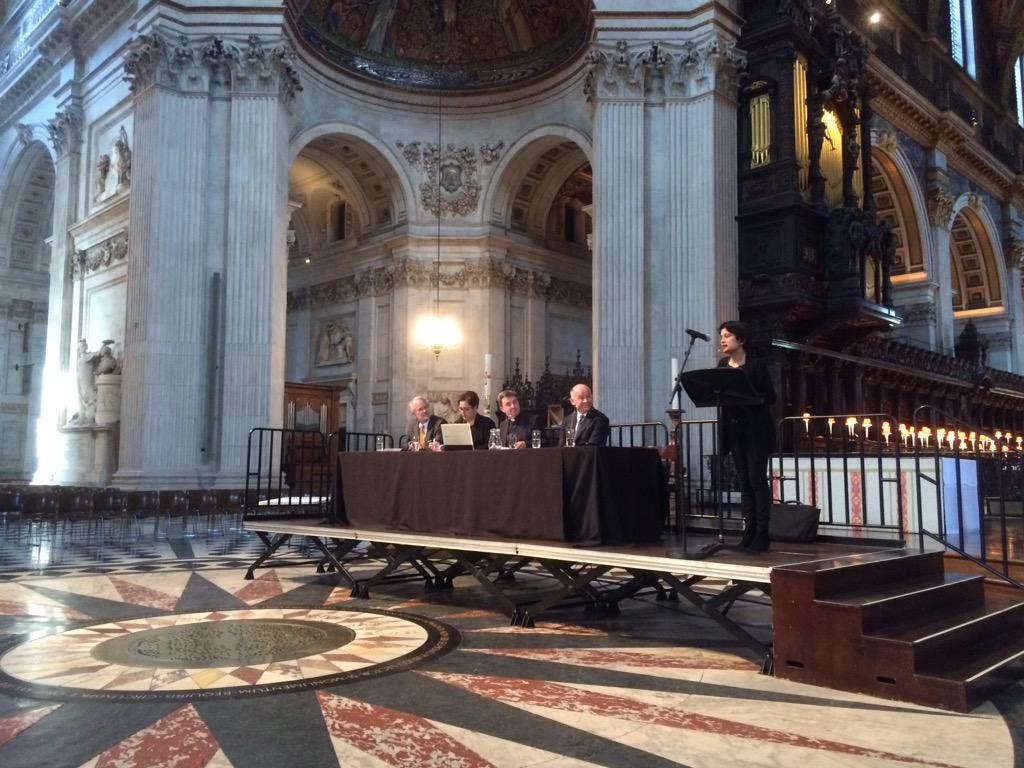
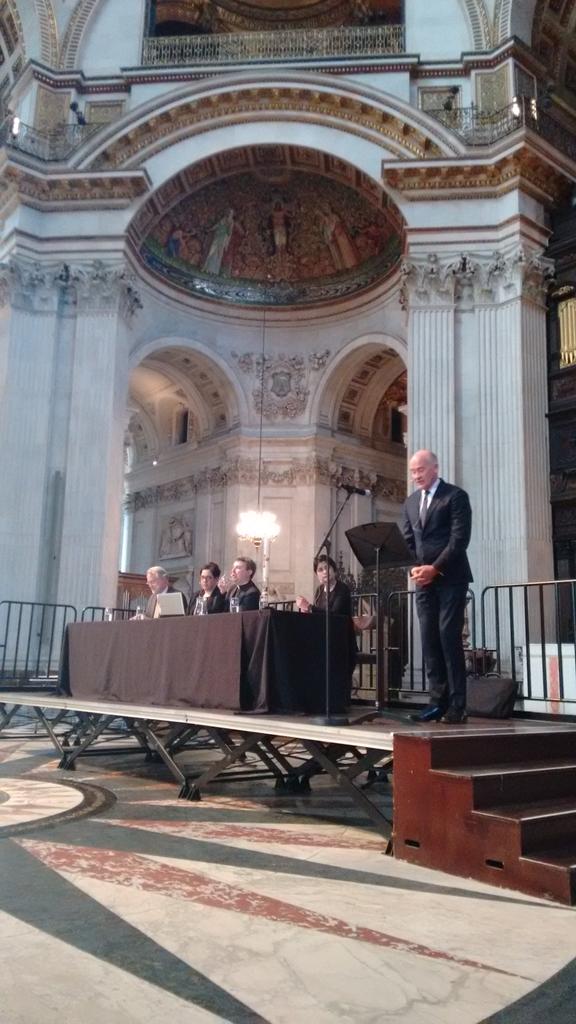
Beyond Election Day: #Power, Money, Government & Responsibility - How do we get #politics & business working for the common good? #GE2015Beyond

I attended this event yesterday evening.  

It was organised by St Paul's Institute in partnership with Theos and Together for the Common Good.  

A summary of the subject, chair and speakers is in the pic to the left of this text, (the 1st page of the event's handout).

The format was some opening remarks by each speaker followed by a Q&A & then some closing remarks from each speaker.  There is a video of the event below. 

At the foot of this post are links to other posts of interest AND pics of the other pages of the handout giving a bit more detail on the chair, the speakers and the organisers of the event.

My summary of the main points I heard being made - using others tweets where available - is below the video.


If I was mega summarising what each speaker said in a couple of lines it would be:

Shami ChakrabartiHer 3 word summary of everything she believes about human rights is dignity, equality and fairness, and the greatest of these is equality

Conor Kehoemaximising long term shareholder is still a good guide for directors to guide what corporations do in the interests of society but assuming long term value is measured by share prices maybe leading people astray.

Loretta MinghellaAny answer to how we address the common good must be able to address the biggest enemies of that common good - climate change, international tax dodging & gender inequality for women

Craig CalhounWe no longer believe politics can be about higher purposes - that we can be more than creatures of self interest. We need a shared purpose and solidarity - common purposes - as part of our society, our country.  Politics when working well can help here

and in a bit more detail ....


Shami Chakrabarti's main points were:

She believes in fundemental human rights & freedoms - not just as a system of law but as ethical values that bind together the whole human family

Her 3 word summary of everything she believes about human rights is ....

Dignity = belief that every single human life is precious - just because they are alive (so not for what they've contributed or their nationality of sexuality or their "goodness" for example)

Equality = equal treatment under the law

Fairness = procedural - a fair hearing, presumption of innocence, access to justice

and the greatest of these is Equality because everybody loves human rights - their own & those like them.  We wouldn't have many of the problems we have if we treated others as we would wish to be treated ourselves.

During a General Election we need to remember that ....


Chakrabarti: democracy must continue in between elections. Much more than casting a vote every 5 yrs

and if we don't then those elected can take our freedoms away (as has happened in other parts of the world during our lifetimes).  Democracy is about fundamental rights and freedoms and the rule of law and these principles keep democracy alive and without them democracy would eat itself.

Some say rights are selfish and they don't build mutuality or responsibility.  Well ....

Do rights allow responsibility? Shami Chakrabarti says a bill of rights is by reciprocity a bill of responsibilities too

Closing remarks on what individuals can do

- democracy not just a 5 year thing

- live your values in your shopping basket and your home


Conor Kehoe's main points were:

2 big ideas drive how corporations are run today 
The headline from Conor's introductory remarks is that maximising long term shareholder is still a good guide for directors to guide what corporations do in the interests of society.  Citizens need to spend £'s on social (as vs for profit) programmes thru the ballot box or their own £'s. But assuming long term value is measured by share prices maybe leading people astray.

The Background to this headline
Shareholder Value - background
A corporation is like a person can enter into contracts - people can invest in and liability is limited to that investment, after all others are paid what is left is profit for investors.  But corporations are a fiction - an imaginary personas an 18th century jurist said "Corporations have neither body's to be punished nor souls to be condemned - they therefore do what they like"

Directors - appointed by shareholders - are responsible for a corporations behaviour.  Shareholders are in the main other large corporations - e.g. pension funds.  So to direct a corporation Directors need to: a) know what is going on; b) ensure their charges adhere to the law and norms of society.

Society allows corporations to exist so how can we ensure corporations act in the best interest of society?  Adam Smith's answer was the "invisible hand" (an owner operating in their own interest to gain more profit in a competitive market).  But that is talking about real people - not the imaginary people that are corporations. 

Friedman & Jenson in 70's & 80's proposed directors should run corporations to maximise shareholder value - today's profits and those out into the future.  As shareholders are the last to be paid after all others therefore maximising their value maximises value for society (competition & search for profit are the regulators much as in Adam Smith's day)

Market Efficiency - background
Share price efficiently puts a value on all those future profit streams that will accrue to shareholders.  But problem is that there is some evidence that the market is short termist.  Even if you don't buy that there is plenty of evidence that CEOs and directors believe the stock market is short termist & so behave accordingly.

Closing remarks on what individuals can do

- get engaged as a consumer and employee and as a member of a pension fund


- use the power of social media

- encourage layers to take a broader view of stakeholder value


Loretta Minghella's main points were:

Climate change is making extreme weather events that kill people or make them homeless more likely - so what are we doing about climate change?

Any answer to how we address the common good must be able to address the biggest enemies of that common good - climate change, international tax dodging & gender inequality for women (Christian Aid's big 3 causes of poverty)

"To promote the common good we must dismantle the environment where poverty can exist"

Christian Aid starts from the position that each person is made in the image of God and so is of inherent dignity and infinite worth.  

Poverty is incompatible with the common good so need to put in place building blocks so personal, social, political and economic power are truly shared and a world n which true charity flourishes

Individual charity = sympathy & giving for anothers plight & is really needed but only creates a temporary sense of connection. Less charitable is the small donation to escape a person asking for charity or some business' CSR programmes so NGOs don't disrupt the AGM.  

True charity = transformational.  Building relationships of integrity which pivot on the idea that we are all equal and all deserve a place at the table.  In a christian sense a full hearted and demanding love, a relentless commitment to what is good for the other manifested in right and just and loving relationships.

To achieve this business and politicians and civil society need to work together.  Of course in all of this we have personal responsibilities (e.g for what we buy from where) but we also need to hold government and businesses to account. 

Examples of such an approach? Dismantling of apartheid or US civil rights movement. Dropping of poor country debt.  These e.gs bear witness to the power of people of like mind coming together in a common cause.  And also, to some extent, to the power of vulnerability - how awesome it is when people put themselves on the line for the freedom of others. 

Business & government find vulnerability difficult to show and change difficult & often get stuck in defensive postures.  Often civil actors can give them the cover to be vulnerable.

Closing remarks on what individuals can do

- we have choices we have to make about the type of world we want to live in - as citizens of the world.  As part of that comes responsibility about connecting and speaking out and taking risks of failure and vulnerability


Craig Calhoun's main points were:

We no longer believe politics can be about higher purposes - that we can be more than creatures of self interest

Politics should be about education and choice: a deeper kind of politics.

Public life should be about - individually and collectively  - an awareness of how we need to grow in awareness and understanding

We need a shared purpose and solidarity - common purposes - as part of our society, our country - politics when working well can help here

We shouldn't accept the premise that the market is a perfectly self regulating system. That is a device by which we analyse it.  Its a partial truth. Markets are interwoven in all of our lives

Government isn't just those in Westminster, through politics it should be something we are all part of.

Politics should enable conditions for engagement.


LSE Director: Social responsibility not just what you do with the money you make but how you make it

Shareholder value shouldn't blind us to all other stakeholders in a business

We should look at market failures - production of bad stuff in production of wealth.

Love isn't just equality it is also connectionClosing remarks on what individuals can do

- gave an e.g. of a single student coming to him and saying LSE should be paying minimum wage

- our society is structured around getting not giving so giving can be sacrificial  - but worth it to embrace a different concept of the good


Soundbites from the Q&A

Shami 

- what links all 4 speaker's contributions is internationalism - this is a shrinking interconnected planet

- the level of information gathering now going on via big data is ripe for abuse

- identity cards invariably become a mechanism for racial discrimination

- voting - a right paid for in courage and blood

Chakrabarti says women have had the vote for less than 100 yrs, so if you can't decide who to vote for vote for a woman (!)

- christian role - more attention to poverty and less to sexuality


Conor 

- big companies are very powerful so we need to hold them accountable


Loretta

- legislation designed to affect danger of business impacting politics seems to have instead focused on charities "sticking to their knitting"

- much more transparency needed on where businesses are making their profits where and how and how and what tax they are paying where and how and how they are using their money to create purchase on the political landscape.  Longer term businesses are at risk from each others excesses (where governments aren't equal to the task)

- if you do not make a contribution to the debate then your voice is missing and nobody else can replace that

- corporations are global but regulation of them isn't - and in short term we won't see global regulation and why transparency is so important

- christianity can speak truth to power


Craig

- often we let our discourse be dominated by how we can prevent the bad rather than what we can do accomplish for the good together

- there are always alternatives to current arrangements - and these alternatives change themselves

- firms should see employees as stakeholders in the firms

- doing business and forming a corporation is a gift from the state 

- political campaigning needs to be reformed to avoid undue influence on politicians of those with money

- land is a big issue for our national output


Q:what does relig bring? says he's a Christian and Christianity offers a willingness to speak about values


- and how to talk about values


other posts on RSA, TED, other lectures, conferences, others blog posts
18 top tips and thoughts about using #social media to enable #community source = an article by  Anatoliy Gruzd PhD & Caroline Haythornthwaite PhD 

2014
Data Protection & Privacy - 8 issues from an International Conference
escape your social horizon limit & understand more - source = a blog post summarising the work of  Jeffrey A. Smith, Miller McPherson & Lynn Smith-Lovin
social media & death - 10 things you may not have thought about - #DORS conference

2013
the development of the U2 spyplane - source = CIA historians Gregory Pedlow & Donald Welzenbach
considering culture and business process improvement  - source = an article by Schmiedel, Theresa, vom Brocke, Jan, & Recker 
ideas that may help you attract older volunteers - source = a paper by Brayley, Nadine, Obst, Patricia L., White, Katherine M., Lewis, Ioni M.,Warburton, Jeni, & Spencer, Nancy
physical factors which help people get better quicker - source = a paper by Salonen, Heidi & Morawska, Lidia 
a new approach to school and education - by Geetha Narayanan 
guiding principles on designing construction kits - by Mitchel Resnick & Brian Silverman
signs of overparenting - source = an article by Locke, Judith, Campbell, Marilyn A., & Kavanagh, David J
making ideas happen - source = a 99U conference

2012
how to spot a liar - by pamela myer 
measuring happiness - source = talk by jim clifton, jim harter, ben leedle


Other pages from the event's handout