license

Creative Commons License
Where the stuff on this blog is something i created it is licensed under a Creative Commons Attribution-NonCommercial-NoDerivs 3.0 Unported License so there are no requirements to attribute - but if you want to mention me as the source that would be nice :¬)
Showing posts with label christian. Show all posts

Thursday, 21 March 2024

How to Live, Forgive, and Hope: A Simple Guide to Christian Beliefs


Photo by Hugues de BUYER-MIMEURE on Unsplash

Christianity is one of the world’s major religions, with over two billion followers. Christians believe in one God, who created the universe and everything in it. They also believe that God sent his Son, Jesus Christ, to save humanity from sin and death. But what do Christians believe about how people should live their lives, forgiveness, what happens when we die, and Jesus? Here is a simple guide to some of the core Christian beliefs.

How to Live

Christians believe that God gave human beings instructions on how to live a good life and get to Heaven after they die. These instructions are called the Ten Commandments, and they are found in the Bible. The Ten Commandments tell Christians to worship only one God, to respect his name and his day, to honour their parents, and to avoid killing, stealing, lying, cheating, and being greedy. Christians believe that by following these rules, they are showing their love for God and their neighbours.

Christians also believe that Jesus taught them how to live by his words and actions. Jesus preached about love, justice, peace, mercy, and forgiveness. He also performed miracles, healed the sick, fed the hungry, and helped the poor. He set an example of selfless love for all people, especially those who were rejected by society. Christians believe that by following Jesus’ teachings and example, they are becoming more like him and pleasing God.

How to Forgive

Christians believe that forgiveness is a very important part of their faith. They believe that God is merciful and forgiving, and that he wants human beings to be the same. They believe that God forgave their sins through the death and resurrection of Jesus Christ. Sin is anything that goes against God’s will and harms the relationship between God and humans. Christians believe that because of sin, they deserve to be punished by God. But they also believe that because of his love, God sent his Son to die on the cross as a payment for their sins. By having faith in Jesus, Christians believe they receive God’s grace, which is his undeserved favour and blessing. This means they believe God has forgiven them and given them the strength to live a good Christian life.

Christians also believe that in order to be forgiven by God, they must forgive others who have sinned against them. They believe that Jesus taught them to forgive without limit, as he did when he prayed for his enemies on the cross. They also believe that Jesus taught them to pray for forgiveness every day in the Lord’s Prayer. The Lord’s Prayer is one of the most important prayers in Christianity, and it includes the phrase: “Forgive us our sins as we forgive those who sin against us.” Christians believe that this means they must forgive others as a condition for receiving God’s forgiveness.

How to Hope

Christians believe that death is not the end of life, but the beginning of a new life with God. They believe that after death, they will face God’s judgement. They believe that those who have faith in Jesus will be welcomed into Heaven, which is a place of eternal joy and peace with God. They also believe that those who reject Jesus will be sent to Hell, which is a place of eternal suffering and separation from God. Christians believe that this judgement is fair and just, because God knows everything about everyone and he rewards or punishes them according to their deeds.

Christians also believe that one day Jesus will come back to Earth in glory and power. They believe that this will be the end of history and the beginning of a new creation. They believe that Jesus will raise all the dead from their graves and judge them according to their faith. They believe that those who belong to Jesus will live with him forever in a new Heaven and a new Earth, where there will be no more sin, pain, sorrow, or death. They also believe that those who oppose Jesus will be thrown into a lake of fire, where they will suffer forever. Christians believe that this is the ultimate hope for humanity and creation.

How to Know Jesus

Christians believe that Jesus is not just a historical figure or a moral teacher, but the Son of God and the Saviour of the world. They believe that he is fully human and fully divine at the same time. They believe that he was born of a virgin named Mary by the power of the Holy Spirit. They believe that he lived a sinless life on Earth, performing miracles and teaching about God’s kingdom. They believe that he died on the cross for the sins of humanity and rose from the dead on the third day. They believe that he ascended into Heaven and sits at the right hand of God the Father. They believe that he is alive today and intercedes for his followers.

Christians also believe that anyone can know Jesus personally by faith. They believe that faith is not just intellectual agreement with facts or doctrines, but trust in a person who loves them and wants to have a relationship with them. They believe that by faith, they can receive God’s forgiveness, grace, and Spirit. They believe that by faith, they can become children of God and members of his family, the Church. They believe that by faith, they can experience God’s presence, power, and purpose in their lives.

Christians believe that knowing Jesus is the most important thing in life, and that nothing can compare to the joy and peace that he gives. They believe that knowing Jesus is not only for this life, but for the life to come. They believe that knowing Jesus is the way to live, forgive, and hope.


Learn more:


Source: I asked Microsoft's CoPilot (and its Chat GPT4) to "Write an article with a read me headline which explains simpliy what Christians believe about how people should live their lives, forgiveness, what happens when we die, Jesus".  The text and post title above is what it prodcuced, wo which I added the picture


Tuesday, 30 April 2019

47min @cmsmission clip - Keynote on #pilgrims, #priests and christian #mission in a post christian culture


Stefan Paas, Professor of Missiology at the Theologische Universiteit, Kampen, Netherlands, gives a keynote on "Pilgrims and Priests: Christian mission in a post-Christian culture" at the Church Mission Society's Pioneer Conversations Day 2019 - Church: Inside out?

Stefan asked some piercing questions about the purpose of mission before proposing priesthood as a way of understanding mission today.

Saturday, 17 March 2018

3min @tearfund clip - Giving God a Chance - David's Story


Text from youtube "Musician, Christian, Hero. In 1968, David became a Christian and one of Tearfund’s first supporters. David tells us why giving God a chance is a decision he’ll never regret. #WeWontStop "

Thursday, 23 February 2017

12min @cofe clip on educating for #Dignity and #Respect


If you're involved or interested in church school's you may find this 12 min clip useful. 

In it the Bishop of Stockport - Libby Lane - tells Adam's story and goes onto to talk about some christian perspectives on this subject. 

The clip was shot on 4/2/17 at Church House, London at the launch conference of the Church of England Foundation for Educational Leadership. 

(found via a tweet by Church of England​ )

Friday, 30 December 2016

5 tips for #hristians in the #public square - inspired & taken from a @TheosThinkTank report

These ideas are taken from Doing good: a future for christianity in the 21st century published December 2016 - a 76 page Theos Thinktank publication. 

Uisng some of my own words and headlines and many from the report I've summarised below the points in it that struck me. 

Recent history & christianity

Over recent history there has been a decline in church attendance as the default identity for those born in the UK has moved from ‘Christian’ to ‘no religion’ (page 11).  


For the majority this loss of Christian identity has not been replaced with atheistic certainty but rather with a personalised spirituality.  The way forward for church is to engage with this deep-rooted human curiosity in ‘things eternal’ through the demonstration of love in ‘things temporal’.  

Some views of the church's past, present or future only describe it in numbers. They are detached from any sense of “life to the full” or of the true meaning of the Kingdom of God that Jesus came preaching (page 11).  

The one trend pertaining to Christianity in contemporary Britain that runs against this narrative of decline is that of ‘social action’.  Levels have risen considerably over the last ten years. There may be fewer people on pews but there are many more running luncheon clubs, and mums and toddlers’ groups, and foodbanks, and homeless charities, and debt advice centres, and drop-in centres, and the like. Christians are ‘doing good’ (page 12)

Doing God, Doing Good & Social Liturgy

The report suggests a view for the future for UK Christianity where "Doing God" is inextricably linked to the practice of "Doing Good" (page 10).  This is service as witness firmly rooted in and unashamed of its faith in Jesus Christ.  

This "Social Liturgy" is a way for Christians to demonstrate their faithfulness to the two greatest commandments – loving God and loving your neighbour – in a way that is both distinctive and inclusive (page 7).  

Social Liturgy is a deliberately unfamiliar phrase.  Leitourgia - the New Testament Greek word can be used to mean both priestly service within the Temple and public charitable activity.   So Social Liturgy is adopted to capture the idea of charitable public action that is also priestly, or directed immediately at the divine (page 12).  It is a simultaneous expression of love of God and of neighbour.  A way of worshipping God through finding and serving him in others. 

The phrase is not simply a return to the admirable but ultimately discredited methods of the social gospel movement of the past.  Social liturgy is just another way of worshipping God in public.  It is this kind of ‘Doing Good’ by which we will "Do God" in the 21st century (page 13)

God has offered every one of us a new start which requires us to show others that they are loved by God (page 11).  This 'Doing Good’ is about coming alongside other people, not as technocratic experts and still less as people whose own lives are fully sorted.  But rather as people who are themselves disciples, or ‘learners’ alert to their own fallibility and need for love and healing. It is not about delivering services but more about developing mutual service between persons, not ‘fixing’ poverty, or problems, or people, but building relationships of common care that recognise, humanise and heal (page 10).  

Christians don't have a monopoly on social action.  People engage in social action for any number of reasons: duty, enlightened self-interest, personal need, undiluted selflessness, and religious conviction. 

We need to guard against the deadening idea that all social action is - or should be - inspired by depersonalised and disinterested motivations, and which sees a ‘hidden agenda’ in anything that appears to deviate from this supposed norm.  All social action should ideally be authentic, true to its own motivations, and that is no less the case for "Social Liturgy". 

Social liturgy should be authentically Christian, marked, among other things, by commitment, love and recognition of the personal nature of all social encounters.  

Other Theos research has indicated that persistence, relationality and localised engagement are just three ways in which the authentically Christian nature of forms of social engagement can manifest itself.  Others – such as an emphasis on hospitality, or hopefulness, or unconditional acceptance – might also apply.  Just as those Christians and churches motivated to serve their communities will do so for authentic theological motivations, they will also need to do so in ways that embody – that really live out – those motivations (Chapter 3).

Dealing with the why questions - why do this - why do it this way?

Knowing the logic that underpins Social Liturgy and enabling that to inform what and how it is done, leads to the need for honest answers to others questions about ‘why are you doing this?’ and ‘why are you doing this in this way?

The answers are ones that are easier to get wrong than to get right. If Christians are doing this because of their Christian faith, they owe it to others to say so.  That, however, can easily send them across the spectrum into the other pitfall which is seeing the curious question as an invitation to deliver a sermon or apologetic lecture.  If there is real potential in the idea of Social Liturgy, there are also problems – or at least potential problems ..... proselytism, pluralism, public legitimacy and public reasoning.  

What follows are some thoughts on getting our answers right to the "why" questions and how they affect these 4 areas.

Proselytism - Some will argue that if Social Liturgy is seen as a future for the church doesn't that mean it is a merely a way of growing the church.  There are two responses to this accusation that bear careful repeating. 

Firstly such an approach is explicitly and repeatedly censured in Christian teaching. In the Sermon on the Mount, Christ is about as clear on the dynamics of gift and service as it is possible to be. Those who claim to follow him should not give with strings attached. Generosity should be generosity, not a covert exchange, whether for favours, social approval or converts.  

Should those engaged in Social Liturgy seek, then, to make ‘disciples’?   They should aim to do what it is there to do – help, heal, counsel, feed, clothe, etc. – and to be open about the theological reason behind it.  If that intrigues and engages people who then proceed to ask questions and enquire about Christianity – good: that is the right moment to respond intelligently and sensitively to any questions asked. If, conversely, it does not intrigue and engage people, who move on without ever wondering about Christianity – good: a genuine human need has still been served and a public good achieved. 

Pluralism - some will argue that in a religiously plural nation like the UK specifically religiously-inspired projects risk destabilising that pluralism and fracturing the concord that underpins any society that is criss-crossed by substantive differences.  

There have been many examples of how Christian public action has worked to calm, rather than provoke, community tensions.  The 2013 Theos report, Making Multiculturalism Work put further empirical evidence on the theoretical bones - “the central criterion for participation is that an organisation must show that it is willing and able to work with people from different backgrounds and perspectives”.

Public Legitimacy - some will argue that a church which is part of the establishment already - but only attracts 2% of people each Sunday - already has too much of a voice in the public square and indeed have forfeited their right to seriously shape our common life which properly should be the right of the other 98%.   

But of course there is no other 98%.  The fact that around 15 million adults call themselves Christians  - even if many rarely darken the door of a church is not immaterial and if it denotes anything it is surely that they have some kind of loose sympathy with the Christian worldview.   More importantly, however, the other 98%, or the other 60%, does not comprise a homogenous whole, whose view is coherent and consistent. 

For all that people formed by different cultural and ideological commitments will disagree about the nature (and even the existence) of a common good, the practical reality tends to be different. Few people actively think that it is wrong to visit the lonely, look after children, provide lunch clubs for the elderly, offer support to the bereaved, provide rehabilitation for addicts, steer drunks from the gutter, give up space for community ventures, support asylum seekers, and host foodbanks, jobs clubs, and debt advice centres. Such activities show a concrete commitment to the public good that you have to try very hard to deny.  

So on this logic, public legitimacy is at least informed by concrete commitment to a palpable public good. The answer to the question ‘why should we pay any (special) attention to what you say?’ lies not in the fact of establishment, nor in the fiction that the non-religious view is homogenous and represented by vocal secular groups. Instead the answer to the question should rest on the demonstrable fact of contributing to the public good. It is those who are doing good – irrespective of whether they are also doing God – who merit most attention in a plural public square such as ours.

Public Reasoning - some have a concern about religious reasoning in public life that draws on textual (e.g. the bible) or institutional (e.g. papal) authorities.  Put simply such authorities are'nt accepted by many others and tend to be unsupported by the evidence. .  Thus it is perfectly legitimate to offer explicitly religious reasons in presenting public justifications for laws or public policies.  Of course although legitimate this does not mean such justifications are necessarily sensible or advisable.  

But we also need to tackle the myth that there is some neutral and universally acceptable way of reasoning.  We all come from somewhere and in part that affects our reasoning. The reality is there is no ‘everyone’ from whom we should expect principled agreement concerning the foundations, logic and language of our argument. Liberal secularism, while priding itself on making space for pluralism, in fact contains unacknowledged exclusivist tendencies that work to close down legitimate diversity. 

In the public square we should expect dissensus rather than consensus, not least about debateable issues.  Public reasoning must pay due attention to the genuinely plural conceptual nature of the public square.  We should not expect agreement on key issues nor should we expect agreement on how to talk about them.  

Arguments need to be grounded in practices.  However just because an institution is delivering a palpable good through society doesn’t mean that its theoretical arguments on that particular topic should win through. ‘Doing Good’ is no substitute for serious arguments and clashing of ideas in the public square.  

Yet if all people are doing is arguing about issues they risk missing the reality of the lives and situations involved.  Arguments are about people and problems, and those arguments that are clearly built on concrete responses to genuine needs should have a particular legitimacy in public debate.

Thursday, 8 November 2012

history of #christianity in 15 #objects No 7: Icon of the Triumph of Orthodoxy


Presented by Dame Averil Cameron.
Warden of Keble College, Oxford until 2010 and previously taught at King's College London


in summary

- the icon is quite small - 12 inches by 15 inches - but is packed with meaning

- it is in the british museum and bought in 1988

- it is generally thought to have been painted around 1400 and is what is know as a feast icon

- so made for one of the liturgical celebrations of one of the feast days in the orthodox church.  its not immediately accessible or understandable as an icon

- like many byzantine icons it had writing on it to identify the figures (but this is now badly damaged) but a later copy from 1500 helps a bit

- so part of the word orthodoxy can just be made out on the right hand side of the icon

- but a byzantine would have known what it was about

- the icon looks back 5 centuries commemorating the end of the long struggle over religious images in byzantium which went on for 100 years ending in AD43 when images were finally vindicated

- that ending was - and is  - known as the triumph of orthodoxy and a new church feast to celebrate such was established (it is still celebrated on the 1st sunday of lent in orthodox churches)

- so as feast icon this object would have been brought out annually for the feast

- there are 2 layers (or ranges) of figures shown on it and the most important ones are the ones at the top.  the 9th century empress theodora and her son - the emperor michael the 3rd - shown as a small child next to his mother, 

- and the patriarch methodios - who presided over the official ending of iconoclasm (the attack on religious images in the 8th and 9th centuries)

- in the scene depicted on the icon the human figures are arranged around another famous icon (now lost for centuries) of the virgin - the mother of god - holding the child in a posture copied many other times in byzantine and italian art - and flanked by 2 angels (the virgin was often show as guarded by such) - and is known in greek as the hodegetria - she who points the way - the icon depicted in our icon was believed to have been brought to constantinople from jerusalem in the 5th century (and to have been painted originally by st. luke).  this icon has disappeared - but it was the most important one in constantinople (it was identified with the city)

- this is the icon the emporer michael the 8th followed on foot in 1261 when he entered constantinople and restored byzantine rule after 50 years of crusader occupation.  it was housed in a monastry named after it - the hodegetria - in later centuries we learn from foreign visitors that it was displayed publically on a weekly basis on tuesdays

- so this great lost icon is painted within our triumph of orthodoxy icon.  it is shown is a form (that we know from other sources) that it was displayed and venerated in and after the 13th century

- the other figures in our icon are all supporters of icons - some of whom had endured persecution or imprisonment or branding by the iconoclast emperors

- so its an icon the commemorates an event.

- so why was it produced at the end of the 14th century? (a time when byzantine orthodoxy had been vindicated after 3 church councils and debates between the western monk barlaam of calabria and gregory palamas  - the great orthodox saint - over palamas's teachings)

- these 14th century councils were held in the very same church in constantinople where the triumph of orthodoxy had been proclaimed in 843

- of course behind those 14th century debates lay the deeper division - enormously heightened by the bitter experience of the crusades - between the orthodox byzantines and the latin catholic west

- so this icon tells a story and it reasserts the claims of eastern orthodoxy over the west

- perhaps it doesn't have the immediate asthetic and spiritual appeal of so many orthodox icons - it needs to be decoded

- we often see icons in museums as though they are art objects but of course that is not how the byzantines saw them.  this icon would have been kissed and revered by every worshipper coming into the church for the liturgy on the sunday of orthodoxy (if you see orthodox christians greet icons now it is almost as if the icons like greeting members of a family) then you become aware that they are infinitely more than just pictures

- what was affirmed in 843 and reaffirmed around 1400 by this icon was that the divine had manifested itself to us in certain specific ways - that the martyrs and the saints pointed the way towards god whose will the angels helped carry out.  that the annunciation to mary, her pregnancy, the birth of christ, his miracles, his suffering with mary at the foot of the cross and hism ascension - were part of the divine economy which were part of god's plan for mankind - the truth of which was revealed in icons

- icons in the orthodox tradition are quite simply about truth.  they are not easy to understand for someone brought up in the western tradition, yet many people respond instinctively to byzantine icons as the byzantines did so many centuries ago

- complex and theological as this icon is, icons have a powerful appeal to religious people and to the unchurched alike - they really are windows to the soul and artifices of eternity


Thursday, 18 October 2012

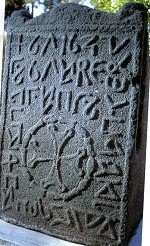
history of #christianity in 15 #objects no. 5: a 6th century stone #lectern from Syria


presented by Dr Sebastian Brock

Former Reader in Syriac Studies, University of Oxford and Professorial Fellow at Wolfson College, Oxford.

in summary

- this stone lectern stands outside the national museum in damascus

- on it is an inscription in syriac which says "may thou be a good memorial for the priest abraham and for john and for his mother who perished"


- 1) the language - syriac - its a dialect of aramaic (a language related to hebrew and arabic).  aramaic was the main language of the middle east until it was replaced with arabic.  it was the everyday language of jesus in the 1st century palestine and his disciples and his earliest followers

- but since greek was the language of government  - and was widely spoken in towns  - it was in greek that the 1st records of jesus were written down in the 4 gospels.  whilst christianity spread westwards in greek - and then in latin - it spread eastwards in aramaic using syriac as its literary language

- by the 4th century syriac christianity was already well established in the persian empire (modern iraq and iran) beyond the eastern borders of the roman empire.  it also spread at an early date to india where - according to an early tradition - st. thomas himself had preached. several churches of syriac tradition continue to flourish in southern india

- by the early 7th century syriac christianity had even reached western china travelling across asia along the so called silk route - and its arrival is recorded in a monumental inscription dated 781 - and syriac christianity was to remain a presence in china until the 14th century when foreign religions were thrown out


- 2) the place - syria - the split in western christianity between roman catholic and reformation churches in the 16th century - and that between the latin catholic west and the greek orthodox east that developed in the early middle ages are well known

- long before this - in the course of the 5th and 6th centuries - a major 3 way split had taken place in eastern christianity in the roman empire (largely forgotten today by western christianity)

- the split was the outcome from 2 church councils which were highly controversial at the time - ephesus (431) and Chalcedon (451) - at stake was the search for a doctrinal formula that would satisfactorily describe the relationship between the divinity and the humanity in the incarnate christ  

- the chalcedon council came up with a formula of faith that gave rise to a great deal of controversy at the time - but eventually by the 6th century the formula was imposed by the emperors as the official church's doctrine.  it was one of several possible formulae of faith - all of which - if rightly understood - were (and are) perfectly acceptable and orthodox

- many in syria and egypt disagreed with the chalcedon formula - and in due course separate hierarchies developed (not recognised by the roman state) - today these hierarchies are represented by: 
a) the syrian orthodox church (along with the armenian, coptic, ethiopian and eritrean orthodox churches (collectively known as the oriental orthodox churches - as distinct from the eastern orthodox greek and russian churches) and 
b) the church of the east - today represented by the assyrian church of the east and the ancient church of the east

- 3) the words - "who have perished" - the memory that there is an indigenous christian tradition in the middle east has largely perished (much like the memory of those on the inscription) as today most people in the western churches think the middle east is inhabited by muslims

- why is this so? - the answer is that the arab conquest of the early 7th century effectively cut off the syrian orthodox church from the late roman empire in which the chalcedon formula was the only one recognised

- thus from the 7th century the non chalcedon churches - living under islam rule - largely vanished from the general conciousness of the greek east and the latin west

- sporadic contact was made during the crusades - and later through western missionaries in the middle east - but it was not until our own times that the situation has begun to change (owing to 2 traumatic events that have happened to the syriac church in the last 100 years)

- firstly - the large scale massacres in eastern turkey during the 1st world war not only of armenian christians but also of syriac christians

- secondly - the massive waves of immigration from the middle east - beginning with those  escaping from the 1915 massacres, and most recently with the huge flight of christians from iraq arising from the invasion of 2003 by usa and uk forces

- so now large numbers of syriac christians are in western european, american and australian territories (e.g. syriac cathedral in east acton London uk) - and western christians have an opportunity to reconnect with such - one largely missing for some 14 centuries

- so christianity ought to be properly viewed as not just consisting of the latin west and greek east but also of a 3rd tradition - which can be termed the syriac orient - each tradition having something to contribute to the others

- so what might the latin west and greek east learn from the syriac orient?

first - in the western tradition theology is a discipline practised in prose - in contrast one of the most profound theologians of the syriac tradition expressed his theological vision in poetry (st. ephrem - died 373) 

second - in syriac liturgical text and literature christ is very often described as the good doctor - and it is primarily medical (rather than legal) imagery that is used in the context of dealing with human sinfulness

third - the syriac churches - being indigenous churches of western asia - provide a non european form of christianity possibly more conducive to african and asian culture

conclusion - perhaps - if you imagine christianity as a table - with only the western and eastern traditions as legs - it is never going to be stable - but with the syriac orient as a 3rd leg .....